
Impact & Evaluation
Tracking how The Nest supports climate emotional wellbeing, connection, and collective action.
Our Evaluation Approach & Early Insights
Our evaluation approach focuses on understanding how participation in The Nest supports climate emotional wellbeing, connection, and motivation for collective action. Using a combination of pre- and post-event surveys and participatory reflection, we capture early trends in emotional processing, coping confidence, and engagement. Findings are used to continuously refine programming as the initiative evolves.
METHOD
Pre- and post-event surveys administered around Nest circles
Measures include emotional coping, sense of community, and motivation for action
Tools designed to be accessible, reflective, and responsive to participant experiences
EARLY OUTCOMES
Participants showed the largest gains in coping confidence, indicating increased capacity to manage climate-related emotions
Emotional responses shifted away from feeling overwhelmed toward more calm, hopeful, and motivated states
Engagement was strong, with most participants expressing interest in attending future events and recommending the experience to others
INTERPRETATION
Peer-based dialogue and emotional validation are central to participant engagement
Combining emotional processing with action-oriented activities supports sustained motivation
Evaluation insights continue to inform facilitation practices and program design
Conference Presentation: Evaluation Results
This evaluation examines how structured, peer-based dialogue and reflective group spaces — like The Nest — support young people in processing climate-related emotions and strengthening motivation for collective action.
Preliminary findings indicate increased coping confidence, stronger feelings of community, and emotional shifts from overwhelm toward calmer, more hopeful, and more engaged states. Together, these insights highlight the value of integrating emotional processing with action-oriented activities in university-based climate wellbeing programming.
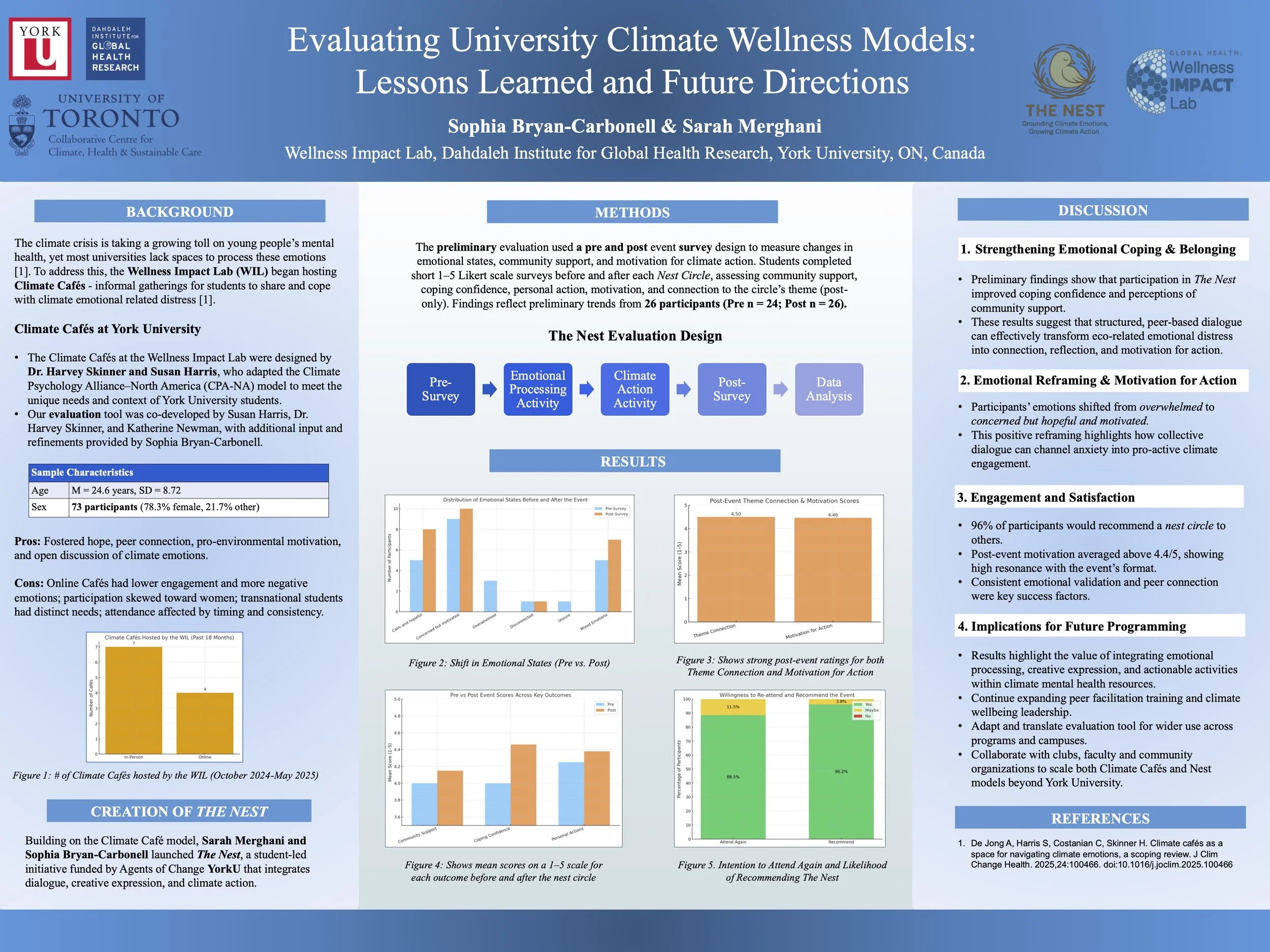
Conference poster presented at University of Toronto